
Ethereum is the world’s most popular smart contract platform, but it’s not without challenges. As adoption grows, the Ethereum mainnet (Layer 1) struggles with high gas fees and slow transaction times. That’s where Layer 2 solutions come in — technologies designed to scale Ethereum and make it accessible for everyone.
Let’s explore what Layer 2 is, how it works, and why it’s critical for the future of Web3.
What Is a Layer 2 Solution?
A Layer 2 solution is a secondary framework built on top of Ethereum (Layer 1) that processes transactions off-chain while still relying on Ethereum’s security.
This allows:
- Faster transaction speeds
- Lower gas fees
- Increased scalability without compromising decentralization
Layer 2 acts like an express lane above the Ethereum highway.
Why Ethereum Needs Layer 2
Ethereum can handle about 15 transactions per second (TPS) on Layer 1. This isn’t enough for mass adoption, especially for DeFi, NFTs, or blockchain games.
Layer 2 helps:
- Reduce congestion on the mainnet
- Enable micro-transactions
- Improve user experience
Without scaling solutions, Ethereum’s high fees could limit its long-term growth.
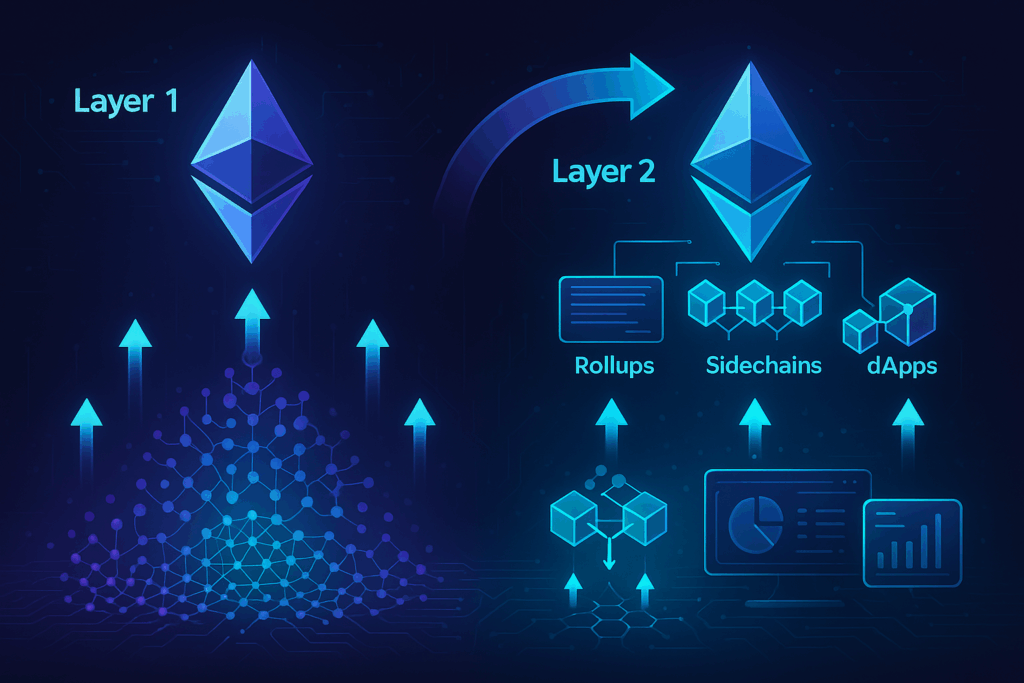
Types of Layer 2 Technologies
1. Rollups
Rollups bundle many transactions into one and submit them to Ethereum in batches.
- Optimistic Rollups (e.g., Optimism, Arbitrum): Assume transactions are valid unless proven otherwise.
- ZK-Rollups (e.g., zkSync, StarkNet): Use zero-knowledge proofs to validate transactions quickly and privately.
Rollups are currently the most widely adopted Layer 2 technology.
2. State Channels
Users lock funds in a smart contract and transact off-chain, only recording the final state on-chain. Great for micro-transactions and gaming.
3. Plasma
Processes transactions off-chain and periodically sends updates to Ethereum. Less used today but historically important in Layer 2 development.
4. Sidechains
Independent blockchains (e.g., Polygon PoS) that run in parallel with Ethereum and communicate via bridges. Offer flexibility, but with slightly different trust assumptions.
Benefits of Using Layer 2
- Speed: Transactions are near-instant
- Cost: Drastically reduced gas fees
- Scalability: Ethereum can support millions of users
- User Experience: Smooth, fast, affordable dApps
Projects like Uniswap, Aave, and OpenSea are already integrating Layer 2 solutions to improve performance.
Challenges and Risks
- Security: Some Layer 2s rely on bridges, which can be hacked
- User confusion: Managing assets across chains and bridges can be complex
- Fragmentation: Too many Layer 2s can lead to ecosystem silos
Despite these risks, the innovation is rapidly improving.
Final Thoughts
Layer 2 is not a “nice to have” — it’s essential for Ethereum’s future. As the blockchain ecosystem grows, scalable infrastructure is key to bringing decentralized apps to billions of users.
Leave a Reply