

While Bitcoin is often referred to as the king of cryptocurrencies, Ethereum is not far behind. In fact, it’s the second-largest cryptocurrency by market capitalization — but Ethereum is much more than just digital money. Understanding the differences between Ethereum and Bitcoin can help you better grasp the broader world of crypto and blockchain.
What Is Ethereum?
Launched in 2015 by Vitalik Buterin and a team of developers, Ethereum is a decentralized blockchain platform that enables developers to build and run smart contracts and decentralized applications (dApps).
Unlike Bitcoin, which is primarily a digital currency used to transfer and store value, Ethereum is a programmable network. This flexibility has positioned Ethereum as the foundation for much of the innovation happening in the crypto space today.
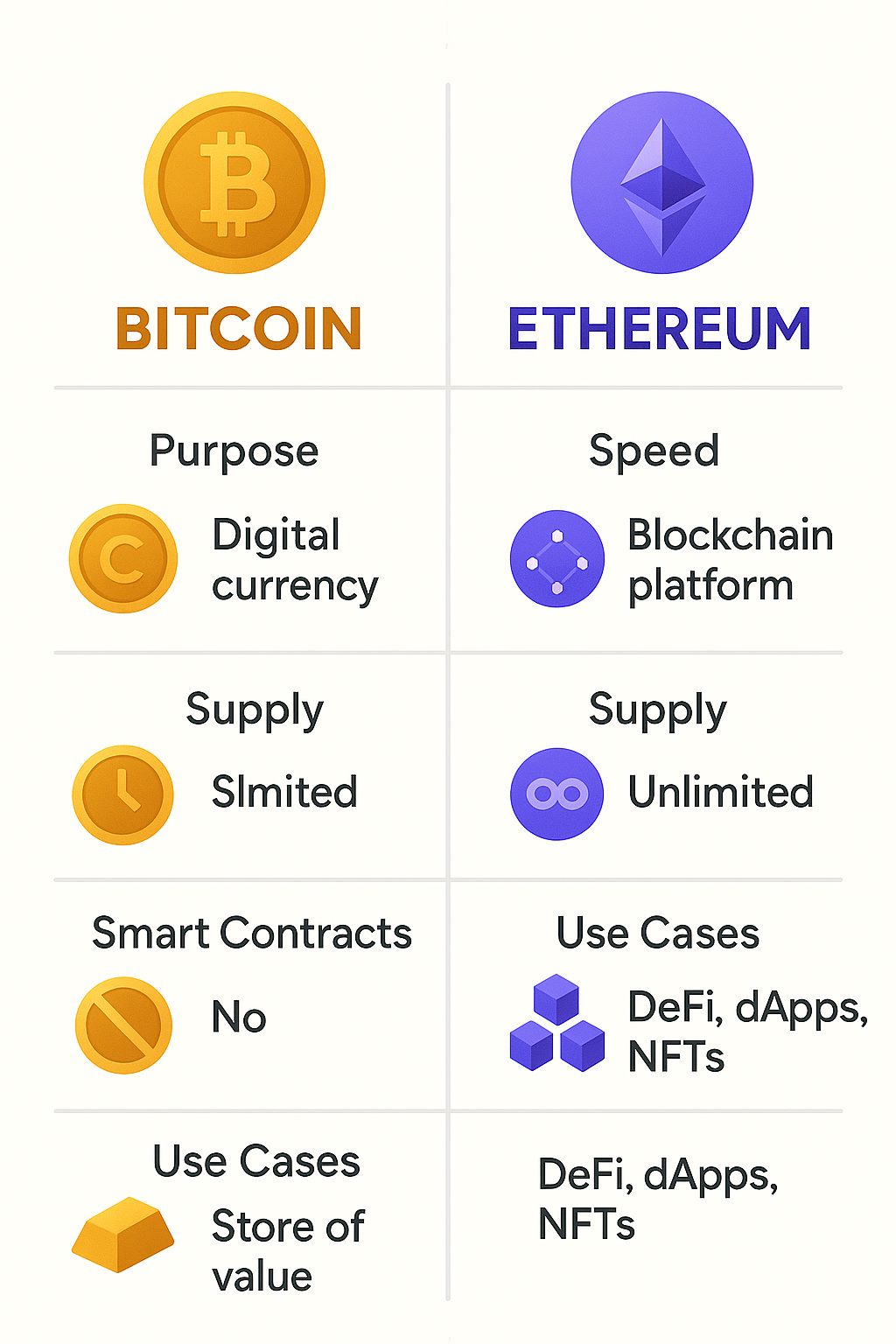
Key Differences Between Ethereum and Bitcoin
1. Purpose
- Bitcoin was created to be a peer-to-peer digital currency and a store of value.
- Ethereum was designed as a platform to build applications and execute smart contracts.
2. Smart Contracts
Ethereum introduced smart contracts — self-executing programs that run exactly as coded. These allow for decentralized finance (DeFi), NFTs, games, and more. Bitcoin does not natively support smart contracts.
3. Speed and Scalability
Ethereum processes transactions faster than Bitcoin and continues to upgrade its network (e.g., Ethereum 2.0) to improve speed, reduce energy consumption, and increase scalability.
4. Monetary Policy
Bitcoin has a fixed supply of 21 million coins, making it deflationary by design. Ethereum does not have a hard cap but introduced a burning mechanism (EIP-1559) to reduce its inflation over time.
5. Technology and Development
Ethereum’s network is more flexible and supports a wider range of use cases, which makes it a hub for innovation. Bitcoin focuses on being a secure and stable store of value.
Which One Is Better?
It depends on your goals:
- If you’re looking for a long-term store of value, Bitcoin is often compared to digital gold.
- If you’re interested in the future of decentralized applications and finance, Ethereum is the platform to watch.
Many investors hold both, seeing them as complementary rather than competitors.
Final Thoughts
Ethereum has played a major role in expanding what’s possible with blockchain technology. From DeFi to NFTs, it’s helping shape the future of how we interact with digital assets.
Want to understand Ethereum in more detail — and learn how to use it safely?
👉 Click here to explore a beginner-friendly crypto course that covers Ethereum and more
Leave a Reply