

As cryptocurrencies and decentralized applications grow, many people are asking: what makes blockchain different from traditional databases? The answer lies not only in how data is stored — but in how it’s secured, updated, and trusted.
What Is a Traditional Database?
Traditional databases, like those used by banks, websites, or businesses, are centralized. That means:
- A single entity (company or institution) controls access and updates.
- Data is stored on central servers.
- Changes can be made by administrators behind the scenes.
Popular database systems include MySQL, PostgreSQL, Oracle, and Microsoft SQL Server.
What Is a Blockchain?
A blockchain is a decentralized, distributed ledger that records data in a chain of blocks. Once a block is added, it becomes permanent and visible to everyone in the network.
Key features:
- Immutability: Data cannot be changed once recorded.
- Transparency: Anyone can view transactions on a public blockchain.
- Decentralization: No single authority controls the system.
The Core Differences
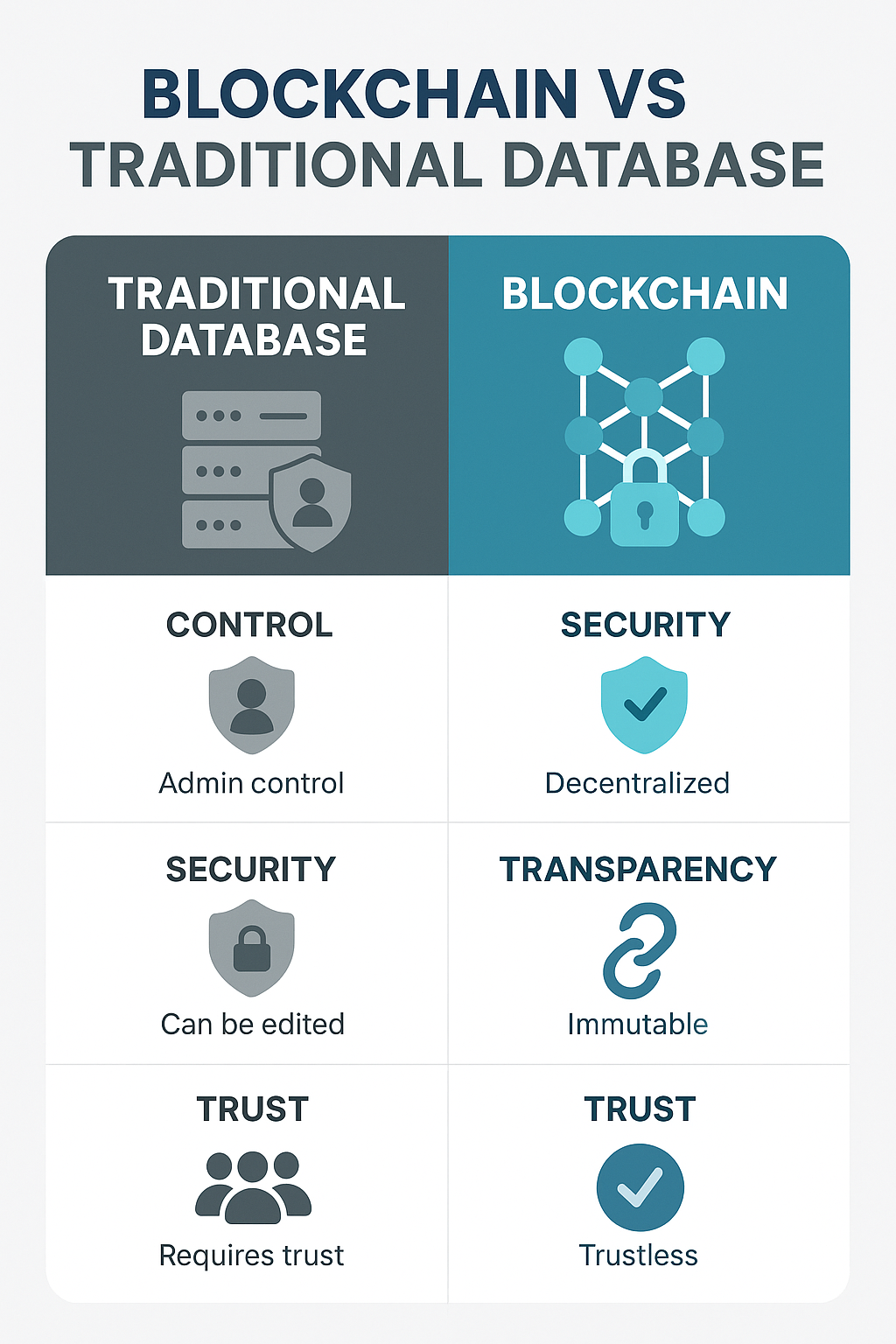
| Feature | Traditional Database | Blockchain |
|---|---|---|
| Control | Centralized (1 entity) | Decentralized (multiple nodes) |
| Data Modification | Admins can edit/delete | Permanent and tamper-proof |
| Security Model | Firewalls and user permissions | Cryptographic + distributed ledger |
| Transparency | Private/internal access | Public and transparent |
| Trust | Requires trusted third parties | Trustless — verified by consensus |
Why Blockchain Is Considered More Secure
- No Single Point of Failure
Because it’s distributed across many nodes, taking down one part doesn’t affect the whole system. - Immutable Records
Once data is added, it can’t be edited or deleted — this prevents fraud or manipulation. - Consensus Mechanisms
Blockchain uses algorithms (like Proof of Work or Proof of Stake) to verify transactions, making it extremely hard to forge data. - Built-in Cryptography
Every transaction is encrypted and linked to the previous one, creating a secure chain.
When to Use Blockchain Instead of a Database
Blockchain isn’t always the better option. But it excels when:
- You need to eliminate middlemen or centralized control.
- Data integrity and auditability are critical.
- Transparency and security are priorities (e.g. financial systems, voting, or asset tracking).
Final Thoughts
While traditional databases are still essential for many centralized systems, blockchain introduces a new level of trust and transparency — especially in environments where data security, audit trails, and decentralization matter most.
Want to understand blockchain and crypto with clarity and confidence?
👉 Click here to explore a complete beginner-friendly course on blockchain and cryptocurrencies
Leave a Reply